


Towel GSM Explained: What 400–700 Actually Means for Your Order
4th Jul 2026
GSM (grams per square metre) measures how much a square metre of towelling fabric weighs — it's a density measurement, not a quality score. Higher GSM means more cotton fibre packed into the weave, which generally means more absorbency and a thicker handle, but it doesn't automatically mean "better." The right GSM depends on how often the towel gets washed and who's using it: 400–450 GSM suits fast-turnaround commercial laundering (gyms, leisure centres), 500 GSM is the everyday home and hospitality balance, and 600–700 GSM suits settings where guest experience matters more than dry time (spas, boutique hotels). We stock the full range from 340 to 700 GSM, and this guide breaks down exactly what each weight is built for.
Most sites won't give you a straighter answer than that, because GSM gets used as a luxury label rather than a spec. If you've ever stared at a GSM filter wondering whether 600 is genuinely better than 450 or just more expensive, here's what the number actually tells you, and how to match it to what you're buying for.
What GSM Actually Measures
GSM stands for grams per square metre — literally, how much a square metre of the towelling fabric weighs. It's a measurement of density, not a quality score. A higher number means more cotton fibre packed into the weave, which generally means more absorbency and a thicker handle. It does not automatically mean "better," and it's not the same thing as thread count, which measures how tightly threads are woven per square inch of fabric rather than how much the fabric weighs. A towel can have a high thread count and a modest GSM, or vice versa — for bath and hand towels, GSM is the more useful number because it tracks absorbency and bulk, which is what actually matters at the sink or poolside.
The honest way to think about GSM is as a trade-off dial, not a ladder. Heavier towels absorb more per wash and feel plusher. Lighter towels dry faster, weigh less in transit and storage, and cost less to launder at volume. Neither end is the "right" answer — it depends entirely on how often the towel gets washed and who's using it.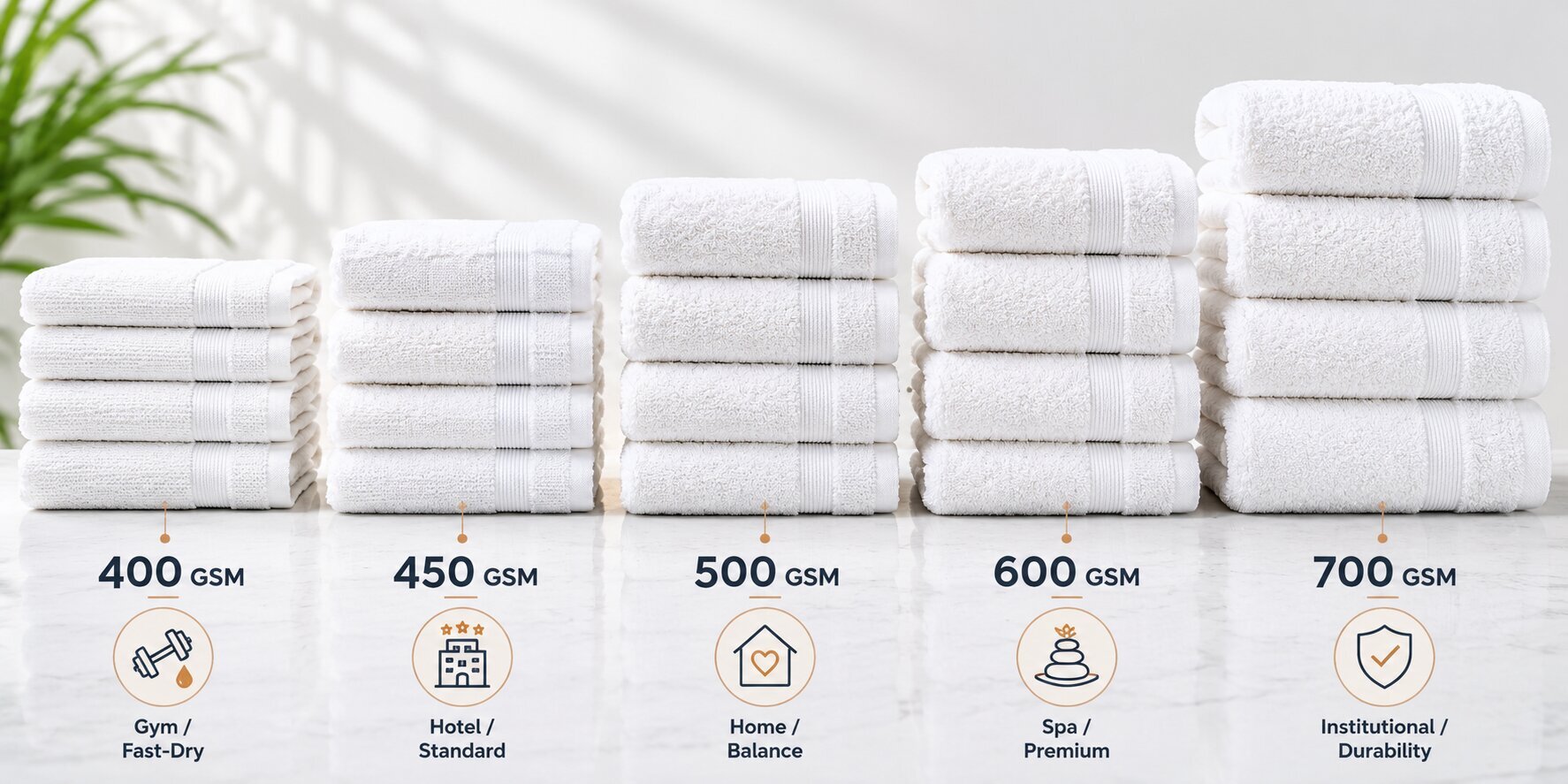
400 to 700 GSM, Tier by Tier
If you need something lighter still, we also stock a 340 GSM leisure towel with the same blue header marker described below — built for the fastest possible turnaround in pool and leisure settings. From 400 GSM up, here's how the range breaks down:
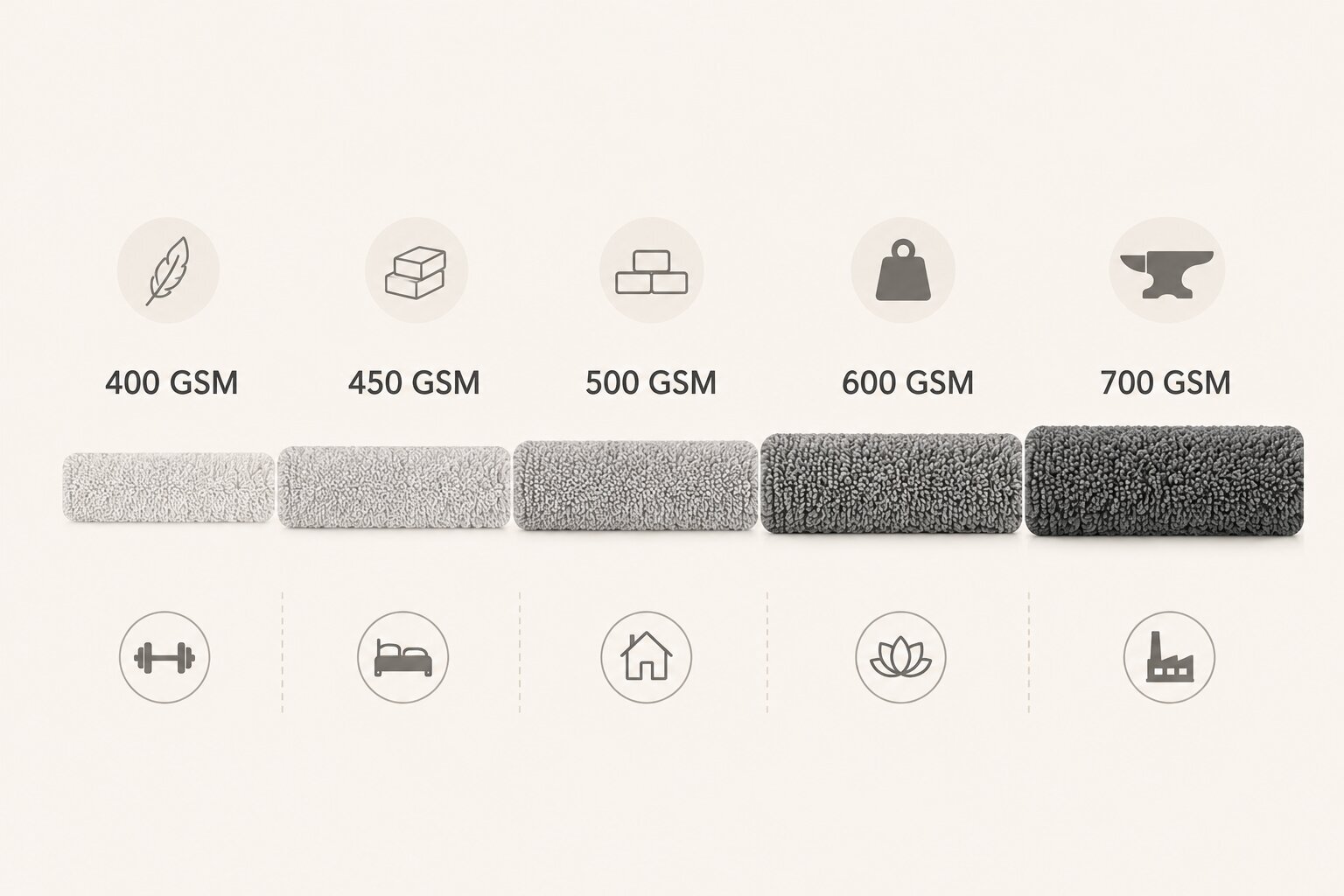
400 GSM — commercial and fast-drying. This is the weight you'll find doing the heavy lifting in gyms, leisure centres, and high-turnover laundries — anywhere a towel gets washed daily and needs to be back on the shelf within hours, not overnight. Lighter fabric means shorter tumble-dry cycles, which matters more to the bottom line than plushness does when you're running hundreds of towels a week. Our 400 GSM range is ring-spun cotton, built for that wash frequency rather than for a long stay on a towel rail.
450 GSM — the UK leisure standard. This is where you'll commonly see a blue header bar — a coloured stripe woven into the hem that's a recognisable marker across UK leisure and hospitality towelling, also used on our 340 GSM leisure range. On our 450 GSM Blue Header Bar towels specifically, it does a practical job: one bar marks a hand towel, two a bath towel, three a bath sheet, so staff can tell sizes apart at a glance when towels are stacked or mid-fold, without checking a label. It's a small detail, but it's the kind of thing that actually speeds up a laundry room.
500 GSM — the everyday balance. If 450 is built around fast turnaround and 600 is built around plushness, 500 sits in the middle — enough density to feel substantial without the longer dry time that comes with the heavier tiers. It's the weight most home buyers land on once they've tried both ends and decided they don't need either extreme.
600 GSM — premium, thick comfort. This is where towels start to feel like they belong in a spa or boutique hotel rather than a budget guesthouse. The extra fibre means more absorbency per towel, which also means a softer drape and a heavier feel straight out of the wash. Worth the trade-off if guest experience is the priority over laundry speed.
700 GSM — maximum density, longest wash life. The heaviest towels we stock, and genuinely the most durable — more fibre per square metre means more material to wear through before a towel thins out. But heavier isn't free: 700 GSM towels take noticeably longer to dry, and for commercial buyers, that's a real laundry-cost consideration, not a footnote. If your towels go through one wash a week, that's irrelevant. If they're in daily commercial rotation, it's worth factoring into your laundry scheduling before you order.
Matching GSM to Your Business
Budget and leisure accommodation — guesthouses, hostels, student lets — tend to do best on 400–450 GSM. Guests don't expect spa-weight towels here, and the faster dry time keeps laundry costs down on properties that turn rooms over quickly.
Boutique hotels and spas are the natural home for 600–700 GSM, where the towel itself is part of the guest experience and turnaround time matters less than how the room feels.
Care homes and institutional settings usually sit best at 400–500 GSM — fast-drying, frequent-wash-cycle territory, where durability and consistency across hundreds of industrial washes matter more than plushness. If you're supplying a care home or hospital, our OekoTex certified ranges are worth knowing about specifically: OekoTex means the fabric has been tested and confirmed free from harmful substances, which is relevant wherever sensitive skin or strict hygiene assessments are part of the buying decision.
Gyms and leisure centres are squarely 400 GSM territory — fast dry times and low per-unit cost matter more here than anywhere else on this list, simply because of wash volume.
A Straight Answer on "Egyptian Cotton"
Our Egyptian Collection and Royal Egyptian Collection ranges are brand names, not origin claims — the cotton is sourced from the USA and South East Asia, not Egypt, and manufactured in ISO 9001 certified factories. You'll see GSM guides — including some of our own competitors' — use "Egyptian cotton" as a quality shorthand, implying the fibre's origin is what makes a towel premium. We want to be straightforward about this rather than let it sit unclarified. The name reflects a quality grade — long-staple fibre, tighter weave, higher GSM options — not where the raw cotton was grown. If origin matters to your buying decision, ask us directly and we'll tell you exactly what you're getting. We'd rather you knew that upfront than find out after a reorder.
Wash Life and Laundering by GSM
For anyone doing the maths on bulk reorders, GSM affects more than how a towel feels on day one. Heavier towels generally hold their structure longer — more fibre means more material has to wear away before a towel thins or frays — which is part of why 600–700 GSM ranges suit settings with lower wash frequency but higher expectations on longevity. Lighter towels in the 400–450 range wear faster individually, but because they're built for high-frequency commercial laundering and dry quicker between cycles, they're usually the more practical choice for operations running daily washes rather than weekly ones. Whichever weight you're on, the basics protect your investment either way: wash with similar colours, skip the fabric softener since it coats the fibres and reduces absorbency, and avoid over-drying, which makes any GSM stiffer over time.
FAQs
What GSM is best for a hotel bath towel?
Most hotels land on 500–600 GSM for bath towels — enough density for a guest-pleasing feel without the extended dry times that come with 700 GSM. Boutique and spa-positioned properties often go heavier; budget and leisure accommodation often go lighter.
Is a higher GSM towel always better quality?
No. GSM measures density and weight, not quality of construction. A well-made 450 GSM towel with tight stitching and good-quality cotton will outlast a poorly finished 600 GSM one. Match the GSM to how often the towel gets washed, not to which number sounds more premium.
What's the difference between GSM and thread count?
GSM measures fabric weight per square metre. Thread count measures how many threads are woven per square inch. They're different metrics measuring different things — for towels, GSM is the more useful number because it tracks directly to absorbency and bulk.
What GSM should I choose for a fast-turnaround commercial laundry?
400–450 GSM. The lighter weight means shorter dry cycles, which adds up across hundreds of washes a week in a way that's easy to underestimate when you're only looking at the per-towel price.
Do heavier towels take longer to dry?
Yes, consistently. More fibre holds more water, so 600–700 GSM towels need longer tumble-dry cycles than 400–450 GSM towels. Worth factoring into laundry scheduling if you're buying for a commercial setting.
Is "Egyptian Collection" the same as Egyptian cotton?
No — it's a brand name reflecting a quality grade, not a claim about where the cotton was grown. Our Egyptian Collection and Royal Egyptian Collection ranges are sourced from the USA and South East Asia and manufactured in ISO 9001 certified factories.
What GSM do you recommend for everyday home use?
500 GSM is the most common choice — enough absorbency to feel substantial without the longer dry times of the heavier tiers. If you prioritise a plush, hotel-style feel over quick drying, 600 GSM is worth the trade-off.
Ready to see the full range? Shop by weight: 340 GSM, 400 GSM, 450 GSM, 500 GSM, 600 GSM, or 700 GSM. Or browse the full towel range by material and use case, including our bath sheets, Bamboo Collection, and Hotel & Institutional Towels. Ordering for a larger property or care setting? Get in touch for tiered pricing on bulk orders.