


BS 7175 Flame Retardant Bedding Explained: What Care Homes, Hotels and Hospitals Need to Know
13th Jul 2026
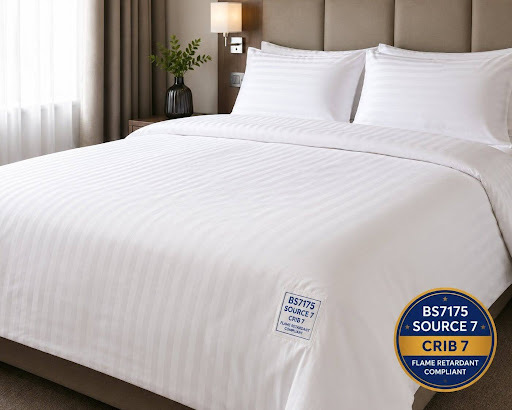
BS 7175 is the British Standard that governs flame retardancy testing for bedding — duvets, pillows, sheets, covers and blankets — in public and institutional environments. It sets out how bedding must perform when exposed to specific ignition sources, and compliance is a legal requirement in most contract and institutional settings in the UK. At Absolute Home Textiles, we stock BS 7175 certified flame retardant bedding across two compliance levels — Source 5 and Source 7 — and can provide certification documentation on request. If you're unsure which level your setting requires, our team can advise: call 01204 653023 or email info@abtex.co.uk.
Fire safety inspections don't give you much warning, and "we assumed this was compliant" is not a position you want to be in when your fire officer arrives. If you manage bedding procurement for a care home, hospital, hotel, or any institutional setting and you're not certain whether your current stock meets BS 7175, this guide gives you a plain-English explanation of what the standard actually means, the difference between the two certification levels we stock, and how to make sure what you're ordering is the right product for your setting.

What BS 7175 Actually Certifies
BS 7175 is a British Standard test method — not a single pass/fail certificate, but a framework of tests that simulate different ignition sources to measure how bedding performs when exposed to flame. The standard applies specifically to finished bedding items: duvets, pillows, sheets, pillowcases, blankets, and bedspreads. It does not cover mattresses, which are governed by a separate standard (BS 7177).
The "source" number in BS 7175 refers to the type of ignition source used in the test. Different sources simulate different real-world fire risks — a smouldering cigarette is a different threat to an open flame, which is a different threat again to the sustained, high-intensity ignition that might occur in a high-risk institutional setting. A product certified to a higher source number has been tested against a more severe ignition scenario.
What compliance actually means in practice: a BS 7175 certified item is not fireproof. It is designed to resist ignition, slow the spread of flame, and self-extinguish rather than continue burning once the ignition source is removed. That distinction matters for how you talk to residents, guests, and staff — it provides significant protection, not an absolute guarantee.
Source 5 and Source 7 — What's the Difference
We stock BS 7175 certified bedding at two levels: Source 5 and Source 7. Both are genuine, currently manufactured product lines with full certification.
Source 5 represents a standard level of flame retardancy, tested against ignition sources that simulate common accidental fire risks. Our Source 5 duvets and pillows use Proban-treated fabric — a controlled chemical treatment process that causes the fabric to form an insulating char when exposed to flame, slowing burn-through and preventing the fire from spreading through the bedding.

Source 7 represents a higher level of ignition resistance, tested against more severe ignition scenarios. Source 7 is a more demanding test, and products that pass it are considered suitable for environments where ignition risk is higher or where a greater margin of safety is required. Our Source 7 duvets and pillows use the same Proban treatment process, but the fabric specification and certification level are distinct from Source 5.
In terms of which level a specific setting requires, this is something you should confirm directly with your fire risk assessor or local fire authority — the requirement depends on your specific setting, its risk classification, and your fire risk assessment, not on a general rule we can responsibly apply for you in an article. What we can tell you is that we hold certification for both levels, can provide documentation on request, and our team is available to discuss which products we've supplied to similar settings: 01204 653023, Mon–Fri 9am–5pm.
How Flame Retardant Fabric Works — Inherent vs Treated
There are two fundamentally different ways a fabric can be made flame retardant, and the distinction matters for how long compliance lasts and how the bedding performs over time.
Treated FR fabric — which includes Proban-treated products — starts as a standard fabric that is then processed with a chemical treatment. The Proban process bonds a flame-retardant compound into the fibre structure, causing the fabric to char rather than ignite when exposed to flame. Treated FR fabric is practical, washable, and widely used across the contract and institutional sector. The key point for buyers managing compliance across repeated laundering: treated FR fabric has a defined wash life, and following the manufacturer's care instructions is not optional — it is how you maintain the certification the product was sold on.
Inherent FR fabric achieves flame retardancy at the fibre level — the material itself is manufactured to resist ignition, rather than being treated after the fact. Inherent FR does not degrade with washing in the same way, because the flame-retardant property is built into the fibre rather than applied to it. It typically costs more than treated FR fabric.
For most hotels, care homes, and institutional buyers purchasing at volume, treated FR fabric — properly laundered to spec — is the practical, cost-effective solution and is widely used across the sector. For settings where laundering consistency is harder to guarantee or where the highest possible longevity is required, inherent FR is worth the additional cost.
Laundering and Maintaining Compliance
This is the part most buyers find out too late: flame retardant compliance on treated fabric depends on how the bedding is washed. If Proban-treated items are laundered at temperatures, speeds, or with detergents outside the manufacturer's specification, the FR treatment degrades faster than it should — and a product that passes BS 7175 on day one may not maintain that performance through its full intended wash life.
The practical rules for maintaining compliance on treated FR bedding: wash at the temperature specified on the label (not hotter, because high heat degrades the treatment), use a mild detergent, avoid fabric softeners and bleach, and tumble dry on a low heat rather than high. For institutional laundries running high volumes, it is worth briefing laundry staff on these requirements specifically for FR items rather than treating them the same as standard bedding stock.

If you are managing a fire risk assessment review and need to confirm the current condition of your bedding stock, our team can advise on what to look for and when replacement is appropriate.
The Full FR Bedding Range at Absolute Home Textiles
We supply BS 7175 certified bedding across the full range of institutional and contract requirements, all available at tiered bulk pricing:
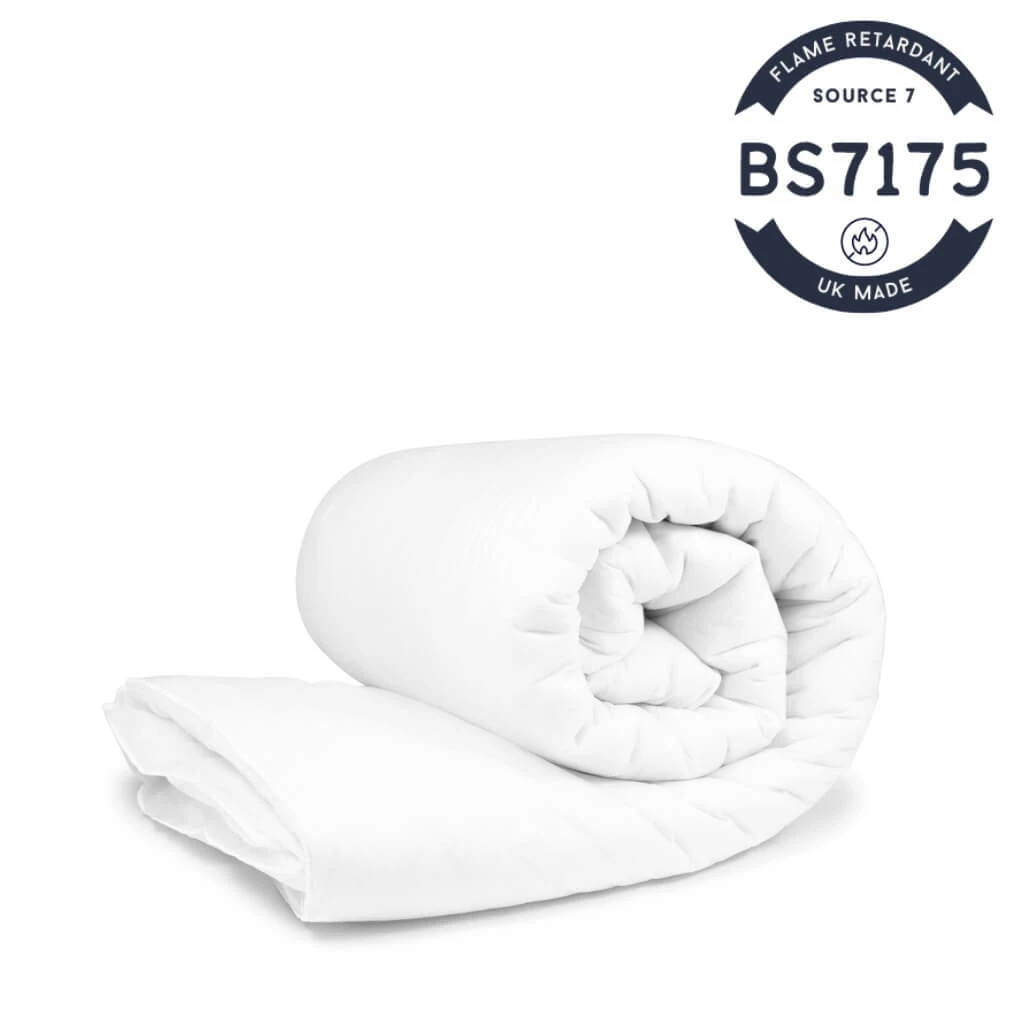
Duvets — Source 5 and Source 7 certified, available in 10.5 tog and 13.5 tog. 100% Hollowfibre Polyester filling, machine washable, tumble dry. BS 7175 badge on product imagery confirms certification level at a glance.
Pillows — Source 5 and Source 7 certified. 100% Hollowfibre Polyester filling, 650 GSM, anti-allergenic, machine washable.
Waterproof and Flame Retardant Duvets and Pillows — PU and Green Tint variants available, combining FR compliance with fluid resistance. Particularly relevant for settings managing incontinence or infection control alongside fire safety requirements.
FR Fitted and Flat Sheets — BS 7175 Crib 7 certified, suitable for institutional use. Available in standard bed sizes.
FR Pillowcases — Envelope style, BS 7175 Crib 7 certified.
FR Cellular and Thermal Blankets — BS 7175 certified, 178x228cm. Standard institutional specification.
Waterproof and FR Mattress Protectors and Duvet/Pillow Protectors — Green Tint, BS 7175 certified.
Certification documentation is available on request for any product in the range. For bulk orders, custom quotes, or confirmation that a specific product meets your fire risk assessment requirements, contact us directly: 01204 653023, info@abtex.co.uk, Mon–Fri 9am–5pm. iwocaPay is available for B2B buyers who need to manage cash flow on larger institutional orders.

FAQs
What is BS 7175 and who needs it?
BS 7175 is the British Standard test method for flame retardancy in bedding — duvets, pillows, sheets, blankets, and covers. It is a legal requirement in most public and institutional settings in the UK, including hotels, care homes, hospitals, prisons, and similar environments. The standard defines how bedding must perform when exposed to specific ignition sources, not whether it is completely fireproof.
What is the difference between BS 7175 Source 5 and Source 7?
Both are compliance levels within the BS 7175 framework. The source number refers to the ignition source used in testing — a higher source number means a more severe ignition scenario was tested against. Source 7 represents a higher level of ignition resistance than Source 5. Both are genuine, currently stocked product lines at Absolute Home Textiles. Which level is required for your specific setting should be confirmed with your fire risk assessor or local fire authority — contact our team and we can provide certification documentation for either level.
Is flame retardant bedding a legal requirement for care homes?
In most cases, yes — care homes and similar settings in the UK are required to use BS 7175 compliant bedding as part of their fire safety obligations. The specific certification level required will depend on your fire risk assessment and local fire authority guidance. We strongly recommend confirming the exact requirement with your fire officer rather than relying on general guidance, including this article. Our team can provide full certification documentation to support your assessment.
If you're sourcing specifically for a nursing home or care home setting, our guide to fire retardant bedding for nursing homes covers the sector-specific compliance points in more detail.
What's the difference between inherent and treated flame retardant fabric?
Treated FR fabric — including Proban-treated products — is standard fabric that has been chemically processed to resist ignition. It has a defined wash life and must be laundered according to the manufacturer's instructions to maintain its certification. Inherent FR fabric is manufactured from fibres that resist ignition by nature, without a chemical treatment applied after the fact — it maintains its FR properties through washing more consistently. Treated FR is widely used and cost-effective for most contract settings; inherent FR is worth considering where laundering consistency is harder to control.
Does flame retardant bedding feel different to sleep in?
Modern FR bedding, including our Proban-treated ranges, is designed to be soft, light, and comfortable in normal use. The Proban treatment process does not significantly alter the handle or feel of the fabric compared to untreated polyester. Our FR duvets and pillows use the same 100% Hollowfibre Polyester filling as standard institutional bedding — the difference is in the outer fabric treatment, not the filling.
How long does flame retardant treatment last?
Treated FR fabric has a defined wash life — the certification is valid for a specified number of washes when the bedding is laundered according to the manufacturer's care instructions. Following those instructions is what maintains compliance over time. Washing at incorrect temperatures or with incompatible detergents will degrade the treatment faster. If you need specific wash-life figures for a particular product, request the certification documentation when ordering.
Can flame retardant bedding be laundered in a commercial laundry?
Yes, provided the laundering is carried out within the manufacturer's specified temperature, detergent, and care guidelines. For institutional laundries running high volumes, we recommend briefing staff on the specific care requirements for FR items separately from standard bedding stock, since the compliance depends on maintaining those conditions consistently across the product's wash life.
Browse our full flame retardant and waterproof bedding range, including FR duvets Source 5, FR duvets Source 7, FR pillows, waterproof and FR duvets, and FR thermal blankets. For bulk orders or certification queries, contact our team directly — we supply hotels, care homes, hospitals, and institutions across the UK, with tiered pricing on volume orders.